

Introduction
Have you ever stared at your crying baby, wishing they came with an instruction manual? You’re not alone. Every day, millions of parents try to decode their little one’s needs without the benefit of words. Learning to interpret baby communication cues is like learning a new language—one that strengthens your bond and helps you meet your baby’s needs promptly.
Before your baby can speak, they’re already telling you exactly what they need through sounds, movements, and baby body language. These early communications form the foundation of your relationship and your child’s future social development.
In this comprehensive guide, you’ll discover how to recognize hunger signs before the crying starts, understand when your baby is overstimulated, and learn the subtle differences between tired fusses and pain signals. Mastering these cues will transform your parenting experience from guesswork to confident care.

- THE BEST BABY SHOWER GIFT: Thoughtfully crafted with parents and babies in mind, this baby registry must-have combines a…
- SENSORY STRANDS INCLUDED: Traditionally sold as an add-on, the Sensory Strands for The Play Gym offer captivating colors…
- LEARN THROUGH PLAY: Every item from The Looker Play Kit is crafted to help babies build new skills through sensory-rich,…
- WHAT’S INCLUDED: The Lovevery Newborn Gift Set comes with our award-winning Play Gym, Sensory Strands, and The Looker Pl…
- WAKE TIME ACTIVITIES: The Looker Play Kit offers specially curated items to keep newborns engaged during their alert per…
Understanding Baby Communication Cues – What Every Parent Should Know
What Are Baby Communication Cues?
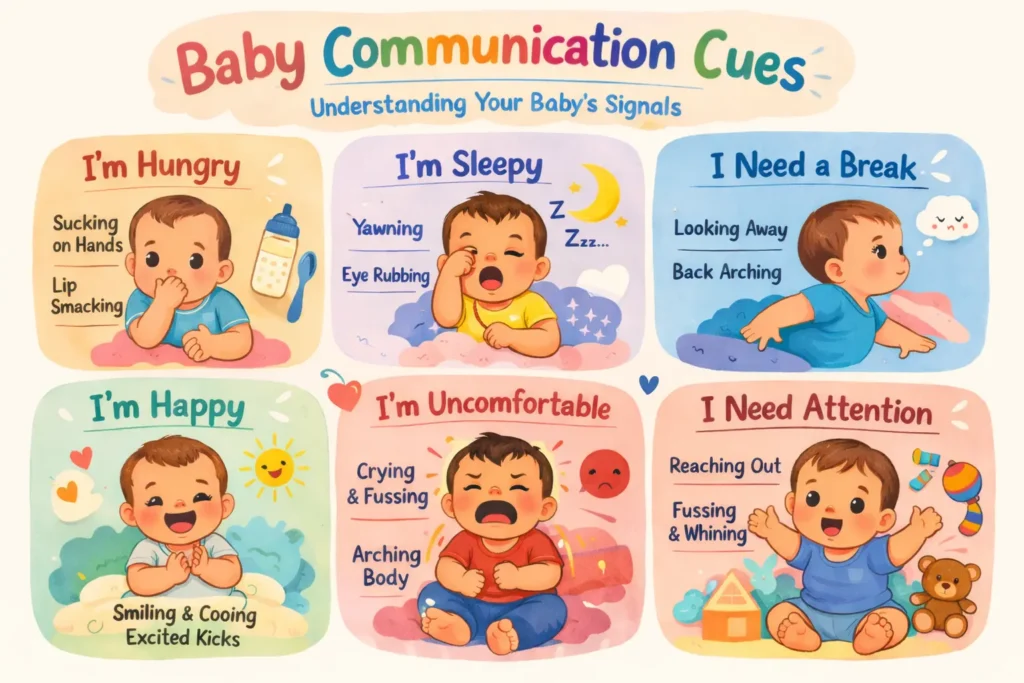
Baby communication cues are the physical signals, sounds, expressions, and movements your baby uses to express their needs, feelings, and desires before they develop verbal language. These cues range from subtle (turning their head away when overstimulated) to obvious (crying when hungry). They include:
- Facial expressions (smiles, frowns, grimaces)
- Body movements (kicking, arm flailing, arching back)
- Vocalizations (cooing, babbling, different types of cries)
- Engagement signals (eye contact, reaching out)
- Disengagement signals (looking away, yawning, hiccupping)
Babies communicate from birth, with their repertoire of cues expanding and becoming more sophisticated as they develop. Understanding these signals allows parents to respond appropriately before minor discomforts escalate into distress.
Why Baby Communication Cues Matter for Your Baby’s Development
Recognizing and responding to baby communication cues plays a crucial role in your child’s cognitive, emotional, and social development for several reasons:
- Brain development: When you respond to your baby’s cues, you strengthen neural connections in their developing brain
- Attachment security: Consistent responses to cues build trust and secure attachment
- Emotional regulation: Helps babies learn to manage their emotions effectively
- Reduced stress: Quick responses to needs keep cortisol (stress hormone) levels lower
- Language foundation: The back-and-forth “conversation” of cues and responses sets the stage for future language development
Research shows that babies whose parents recognize and respond to their cues consistently tend to have stronger social-emotional outcomes and more advanced communication skills later in childhood.

- 【Voice Mimicking Toys】Upgraded Smart bunny rattle repeats what you say. This Baby toys 0-6 months can record what you sa…
- 【Safe Materials & Light-Up Ears】The baby rattle ears are made of soft, RoHS-certified silicone that’s safe and gentle fo…
- 【Early Education Learning Toys】This learrning toys for toddler 1-3 plays 13 nursery rhymes, 13 bedtime stories and 5 smo…
- 【Cute &User-Friendly Designs】Charged using micro USB cable (included). Baby can play with it for 4 hours. No extra batte…
- 【Best Gift for Baby】 The perfect gift for the 0-24 months babies, Suitable for Newborn infant baby boy girl gifts.This i…
Common Myths About Baby Communication Cues
Many misconceptions persist about how babies communicate, leading to misinterpretation of their needs:
Myth 1: Babies cry only when hungry
Reality: Crying is a late hunger sign. Earlier cues include rooting, lip-smacking, and hand-to-mouth movements.
Myth 2: You’ll spoil a baby by responding to every cry
Reality: Responding to baby communication cues builds security, not dependency. Babies who receive consistent care actually become more independent later.
Myth 3: Babies use crying to manipulate parents
Reality: Babies lack the cognitive ability to manipulate. Their communication is always about genuine needs.
Myth 4: All crying sounds the same
Reality: Babies have different cries for different needs – experienced parents often distinguish hunger cries from tired or pain cries.
Myth 5: Babies should self-soothe from an early age
Reality: Self-soothing develops gradually with parental support, not through being left to “figure it out.”

- 37 Easy To Understand Talking Buttons- Our AAC device for speech comes with 37 pre-installed instructions in a picture a…
- 1 Male/Female Voice Switch & 8 Programmable Buttons- AAC device for autism features a male and female voice switch butto…
- Adjustable Volume- AAC Communication Device for Speech Therapy Requires 3AAA batteries, the sound is louder and louder, …
- A Wide Variety Of Uses- The non verbal communication tools are suitable for a wide range of individuals, including non-v…
- Reduce Anxiety and Build Confidence- The Talker Buddy Build confidence and understanding by Clicking the button to expan…
Essential Items & Supplies for Recognizing Baby Communication Cues
Must-Have Products for Understanding Baby Communication Cues
Certain tools can help parents become more attuned to their baby’s signals:
- Baby Monitor with Video: Allows you to observe subtle baby body language even when you’re not in the room
- Swaddles and Sleep Sacks: Help identify sleep cues by providing a consistent sleep environment
- Pacifiers: Can help distinguish between hunger and comfort-seeking behaviors
- White Noise Machine: Assists in recognizing overstimulation cues by providing sensory regulation
- Baby Carrier/Wrap: Enables close observation of subtle cues through physical proximity
| Product Type | Benefits for Recognizing Cues | Recommended Features |
|---|---|---|
| Video Monitor | Visual confirmation of subtle movements; pattern recognition | Night vision; two-way audio; movement sensors |
| Baby Carrier | Physical feedback from baby’s body; immediate awareness of tension/relaxation | Ergonomic design; suitable from birth; adjustable positions |
| White Noise Machine | Helps identify if baby is reacting to environmental stimuli | Multiple sound options; auto-timer; portable design |
| Swaddles | Makes startle reflexes and sleep cues more obvious | Breathable fabric; secure fastening; appropriate sizing |
| Feeding Journal App | Tracks patterns to predict needs before cues intensify | Customizable categories; data visualization; reminder features |
Optional but Helpful Items
Beyond the essentials, these items can further enhance your ability to read your baby’s signals:
- Smart Baby Clothing: Monitors breathing patterns and sleep positions
- Temperature Gauge: Helps determine if fussiness is related to environmental comfort
- Books on Infant Development: Provides age-appropriate context for emerging communication abilities
- Mirror for Tummy Time: Allows observation of facial expressions during play
- Developmental Toys: Helps gauge engagement and disengagement cues during playtime
These tools don’t replace parental intuition but can provide additional data points to confirm your observations.
Budget-Friendly Alternatives
You don’t need expensive equipment to become proficient at reading baby communication cues:
- Homemade sensory toys: Create high-contrast images using black and white paper to observe visual engagement cues
- DIY white noise: Use a fan or air purifier instead of a specialized machine
- Repurposed household items: Kitchen timers can track feeding intervals; scarves can become impromptu carriers
- Phone apps: Free baby tracking apps instead of specialized devices
- Library resources: Borrow parenting books rather than purchasing
The most valuable tool is consistent, attentive observation—something that costs nothing but yields invaluable insights.
Guide to Interpreting Baby Communication Cues
Preparation Steps
Before you can effectively respond to your baby’s cues, establish these fundamentals:
- Learn the basics of infant development: Understand what communication capabilities are age-appropriate
- Create observation opportunities: Establish daily routines that include uninterrupted one-on-one time
- Minimize distractions: Reduce phone usage and background noise during key interaction times
- Establish a tracking system: Use a simple notebook or app to record patterns in feeding, sleeping, and fussing
- Build your support network: Connect with other parents and professionals who can provide guidance
Additionally, prepare yourself mentally by adopting a curious, patient mindset. Interpreting baby communication cues requires focused attention and willingness to experiment with different responses.
Implementation Process
Follow these steps to become fluent in your baby’s unique communication style:
- Observe baseline behavior: Note your baby’s typical expressions, movements, and sounds when content
- Document changes: Record deviations from baseline that precede crying or distress
- Test responses: When you notice a cue, try a specific response (feeding, changing, soothing) and note effectiveness
- Identify patterns: Look for correlations between specific cues and particular needs
- Refine timing: Work toward responding to early cues before they escalate to crying
- Create a personalized cue dictionary: Document your baby’s unique signals for reference
Remember that this process requires continuous adjustment as your baby develops new abilities and preferences.
Troubleshooting Common Issues
Even experienced parents encounter challenges when interpreting baby body language:
Challenge: Multiple cues happening simultaneously
Solution: Address physical needs first (hunger, discomfort), then emotional needs (overstimulation, boredom)
Challenge: Cues changing as baby develops
Solution: Reassess and update your understanding monthly during the first year
Challenge: Inconsistent responses to the same cue
Solution: Consider context (time of day, recent activities) and potential developmental leaps
Challenge: Difficulty distinguishing between similar cues
Solution: Video record episodes to review and identify subtle differences in expressions or sounds
Challenge: Parental fatigue interfering with observation
Solution: Implement a rotation with a partner or caregiver; simplify tracking during overwhelming periods
Top 5 Benefits of Understanding Baby Communication Cues for Baby & Parents
Developmental & Health Benefits for Baby
Responding appropriately to baby communication cues provides substantial advantages for your child:
- Enhanced Neurological Development: Timely responses to cues strengthen neural pathways related to cause-and-effect understanding
- Improved Digestive Health: Recognizing early hunger cues prevents overfeeding and reduces colic symptoms
- Better Sleep Patterns: Identifying tiredness signs before overtiredness leads to more restorative sleep cycles
- Advanced Language Acquisition: The “conversations” created through cue-response patterns accelerate language development
- Stronger Emotional Regulation: Babies whose cues receive consistent responses develop better self-soothing abilities
These benefits create a foundation for lifelong health and developmental advantages that extend well beyond infancy.
Advantages for Parents
Parents who become skilled at reading baby communication cues experience significant benefits themselves:
- Reduced stress: Addressing needs before full-blown crying creates a calmer household environment
- Increased confidence: Understanding your baby’s signals builds parental self-efficacy
- More efficient care routine: Anticipating needs saves time and emotional energy
- Deeper bonding: The attunement required for cue reading strengthens parent-child connection
- Better sleep: Parents who respond to early sleep cues often report improved sleep for the whole family
Many parents report that becoming proficient in reading their baby’s cues transforms parenting from overwhelming to intuitive and rewarding.
Long-Term Impact on Family Wellbeing
The benefits of early communication extend beyond infancy to create lasting positive effects:
- Secure attachment patterns that influence future relationships
- Effective communication habits that prevent power struggles during toddlerhood
- Parent-child synchrony that supports emotional development through childhood
- Reduced behavior challenges as children feel understood and respected
- Foundations for emotional intelligence that benefit social relationships throughout life
Research suggests that families who prioritize understanding communication cues in infancy report smoother transitions through developmental stages and stronger family relationships overall.
Expert Tips, Alternative Methods & Age-Specific Advice
Tips for Newborns (0-3 Months)
During the fourth trimester, babies communicate primarily through reflexive behaviors:
- Rooting and mouth movements indicate hunger before crying begins
- Jerky limb movements and facial grimacing often signal gas pain
- “Worried eyebrows” frequently precede overtiredness
- Gaze aversion and hiccups typically indicate overstimulation
- Hands near face with fussing usually means tiredness
For newborns, timing is particularly important—tracking intervals between feedings and sleep helps anticipate needs before cues become pronounced. Consider wearing your baby in a carrier to become attuned to subtle baby body language changes that signal emerging needs.
Adjustments for Older Babies & Toddlers (3+ Months)
As babies develop, their communication becomes more intentional and sophisticated:
- 3-6 months: Watch for increased use of vocalizations to express needs; babbling may change tone for different requests
- 6-9 months: Observe pointing, reaching, and other intentional gestures that replace some crying
- 9-12 months: Note early word approximations and consistent sounds for specific needs
- 12+ months: Look for combined cues like pointing while vocalizing to make specific requests
Older babies often develop personalized signals for specific needs—like a particular bounce when tired or a specific sound when hungry. Creating a responsive environment that acknowledges these emerging communication efforts encourages further language development.
Alternative Methods & Different Parenting Styles
Various parenting philosophies offer unique perspectives on interpreting baby communication cues:
- Baby Sign Language: Teaching simple signs for basic needs can bridge the gap between non-verbal and verbal communication
- RIE Approach: Focuses on observing babies without intervention to better understand their natural communication
- Attachment Parenting: Emphasizes physical proximity to enhance cue recognition through constant contact
- Montessori Method: Creates environments that allow babies to communicate preferences through choices
- Cultural Variations: Different cultures prioritize different cues based on parenting values and traditions
The best approach combines methods that align with your family’s values while respecting your baby’s unique temperament and communication style.
Conclusion
Becoming fluent in your baby’s non-verbal language transforms parenting from guesswork into a rewarding conversation. By learning to recognize baby communication cues, you’re not just meeting immediate needs—you’re building neural connections, establishing trust, and creating foundations for lifelong emotional health.
Remember that interpreting these signals is a skill developed through practice, not perfection. Even experienced parents sometimes misread cues or respond to the wrong need first. What matters most is your consistent attentiveness and willingness to respond, which tells your baby they’re worth listening to.
As you continue your journey of understanding baby communication cues, your confidence will grow alongside your baby’s trust in you. This dance of communication forms the foundation of your relationship and teaches your child that their voice—even before words—matters deeply.
Which baby communication cues have you noticed in your little one? Share your experiences in the comments below to help other parents on their journey of understanding their babies’ unique language!
FAQs
How early can babies begin showing communication cues?
Babies begin showing baby communication cues from the moment they’re born. Newborns communicate primarily through reflexive behaviors and cries, but even these earliest signals convey specific needs. Within the first weeks, you’ll notice rooting movements when hungry, turning away when overstimulated, and distinctive cries for different situations. By 2-3 weeks, many babies develop a social smile in response to their caregivers’ faces, representing one of the first intentional communication efforts.
By the end of the first month, most parents can distinguish between different types of cries and basic baby body language. It’s important to respond to these early cues consistently, as this establishes the foundation for more complex communication. Remember that every interaction with your newborn is teaching them about the effectiveness of their communication efforts and building their trust in the world.
What’s the difference between hunger cues and tired cues?
Distinguishing between hunger and tiredness in baby communication cues can be challenging since both may eventually lead to crying. Hunger cues typically progress in this sequence: licking lips, bringing hands to mouth, rooting (turning head with open mouth), increased physical activity, and finally crying. Hunger cries often start slowly and build in intensity, with a rhythmic pattern.
Tired cues follow a different progression: decreased activity, reduced interest in surroundings, rubbing eyes or ears, yawning, fussiness when overstimulated, and jerky limb movements. Tired cries often sound whiny or nasal and may be accompanied by eye rubbing or ear pulling. The timing since the last feed or nap provides important context—a baby who ate 30 minutes ago is more likely tired than hungry, while one who has been awake for several hours might be showing both cues simultaneously.
How can I tell if my baby is overstimulated versus bored?
Baby communication cues for overstimulation and boredom appear quite different once you know what to look for. An overstimulated baby typically shows signs of sensory overload: gaze aversion (looking away), hiccupping, sneezing, yawning, arching the back, frantic movements, and eventually crying that intensifies when more stimulation is added. Their body language becomes increasingly tense and they may develop a glazed look or suddenly become very fussy.
Conversely, a bored baby actively seeks engagement: making eye contact, following movement with increased alertness, cooing or babbling to get attention, and showing pleased expressions when new stimulation is introduced. Their body remains relatively relaxed, and they may look around seeking visual interest. Boredom cues generally involve increased alertness and active seeking of stimulation, while overstimulation cues involve efforts to reduce or escape sensory input.
Can baby communication cues vary based on temperament?
Yes, baby communication cues can vary significantly based on temperament. Babies with more sensitive temperaments often display subtle early cues that escalate quickly to distress if not addressed. They may show more pronounced reactions to hunger, tiredness, or discomfort and require more immediate responses. These babies typically have a narrower “window of tolerance” for discomfort before crying.
Babies with more laid-back temperaments might show more gradual progressions through their cues, giving parents longer to respond before reaching full distress. They may use more subtle baby body language that requires careful observation. Some babies naturally communicate more through vocalizations, while others rely more on physical movements or facial expressions.
Understanding your baby’s temperament helps you interpret their unique communication style and adjust your response timing accordingly. A baby’s temperament isn’t “good” or “bad”—it simply requires different parental adaptation to meet their needs effectively.
How do baby communication cues change as they grow older?
Baby communication cues evolve dramatically throughout the first year as cognitive and physical abilities develop. Newborns communicate primarily through reflexive behaviors and crying. By 2-3 months, social smiles, coos, and more distinctive cries emerge. Between 4-6 months, babies add intentional movements like reaching and recognizable emotional expressions to their repertoire.
The 7-9 month period brings significant advancement with the development of intentional gestures like pointing, waving, and showing objects. Babies this age begin combining vocalizations with gestures to make specific requests. From 10-12 months, proto-words (consistent sounds for specific objects) appear, along with more complex gestures and clearer emotional expressions.
Throughout these stages, earlier communication methods don’t disappear but are supplemented by new abilities. Parents need to continuously update their understanding of their baby’s evolving communication system. What worked as a response at 2 months may need adjustment at 6 months as babies develop more specific ways to communicate their increasingly sophisticated understanding of the world.