This post may contain Affiliate links. If you buy anything via the link, I will earn a small commission without any effect on your payment. Thank you for your support.
Introduction
Have you ever purchased what seemed like the perfect outfit for your little one, only to find it’s too small before they even wear it? You’re not alone! Finding the right size clothing for rapidly growing babies can feel like solving a complex puzzle. A comprehensive baby clothing size guide is essential for every parent’s sanity and budget. With babies growing at different rates and clothing brands using inconsistent measurements, understanding how to navigate infant clothing sizes becomes a crucial parenting skill.
In this complete guide, we’ll decode the mysteries of baby clothing sizes, provide practical charts based on age and measurements, and share expert tips to ensure your little one always has comfortable, properly fitting clothes. Whether you’re a first-time parent preparing a nursery or an experienced caregiver struggling with size inconsistencies, this resource will become your go-to reference for all things related to baby clothes sizing.
Understanding Baby Clothing Size Guide – What Every Parent Should Know

What is a Baby Clothing Size Guide?
A baby clothing size guide is a comprehensive reference tool that helps parents select appropriately sized clothing for their infants based on age, weight, height, and specific brand measurements. Unlike adult clothing, which follows somewhat standardized sizing, baby clothes vary significantly between manufacturers, countries, and even different clothing types. These guides typically include detailed measurements for chest, waist, length, and weight ranges, allowing parents to make informed purchasing decisions.
Most standard guides categorize baby clothing into age brackets (newborn, 0-3 months, 3-6 months, etc.), but the most reliable guides acknowledge that babies grow at different rates and include measurement-based recommendations. A thorough baby clothing size guide also accounts for seasonal considerations, fabric types, and growth spurts to ensure maximum wearability.

Why Baby Clothing Size Guide Matters for Your Baby’s Development
Properly fitted clothing isn’t just about aesthetics—it directly impacts your baby’s comfort, mobility, and development. Clothes that are too tight can restrict movement, potentially hampering physical development during crucial growth stages. Conversely, excessively loose clothing can pose safety hazards, with fabric that might bunch up or catch on objects.
Temperature regulation is another critical factor. Babies cannot regulate their body temperature as efficiently as adults, making properly sized seasonal clothing essential. An accurate baby clothing size guide ensures that summer clothes allow adequate airflow while winter clothing provides sufficient warmth without overheating.
Additionally, clothing that fits well promotes independence as babies begin to explore movement. When outfits are comfortable, babies can practice rolling, crawling, and eventually walking without unnecessary restrictions, supporting natural developmental progression.
Common Myths About Baby Clothing Size Guide
Myth 1: Age-based sizing is always accurate.
Reality: Age is just a starting point. An infant size chart by age should be used as a general guideline, not a rule. Some 3-month-olds may wear 6-month clothing, while others might still fit in newborn sizes.
Myth 2: Sizing is consistent across brands.
Reality: There’s significant variation between manufacturers. A Carter’s 3-month size might be equivalent to a Gerber 6-month size. Always check brand-specific charts when available.
Myth 3: You should always buy the current size.
Reality: Purchasing slightly larger sizes allows room for growth, especially for seasonal items. However, extremely oversized clothing can be uncomfortable and potentially unsafe.
Myth 4: European and US sizes are interchangeable.
Reality: International sizing follows different standards. European sizes typically reference height in centimeters, while US sizes are generally age-based, creating notable discrepancies between numbering systems.

Essential Items & Supplies for Baby Clothing Size Guide
Must-Have Products for Baby Clothing Size Guide
Flexible Measuring Tape: A soft, flexible tape measure is essential for accurately measuring your baby’s chest, waist, and length. Fabric or plastic versions designed for sewing work perfectly.
Growth Tracking App: Apps like Baby Tracker or Glow Baby help record your child’s measurements over time, making it easier to predict size changes and plan purchases.
Size Organizers: Closet dividers or drawer organizers labeled with sizes help keep clothing sorted as your baby grows through multiple sizes.
Adjustable Clothing: Garments with features like roll-up cuffs, adjustable waistbands, and stretchy fabrics provide flexibility as your baby grows, extending wear time.
Clothing Extenders: These clever devices attach to onesies and pants to extend their usable life when babies are between sizes.
Comprehensive infant size chart by age: A laminated or digital reference chart that includes measurements for different brands can be invaluable when shopping
Optional but Helpful Items
Digital Baby Scale: While not necessary, a scale helps track weight gain, which correlates closely with clothing size needs.
Clothing Labels: Repositionable size labels help track which clothes are which size, especially useful for hand-me-downs that may have faded tags.
Size Prediction Calculator: Some online tools use your baby’s current growth patterns to predict future sizing needs.
Storage Containers: Clear, labeled bins for storing outgrown clothes or future sizes keep your organization system intact.
Clothing Swap Group Membership: Local or online groups where parents exchange outgrown clothes can be budget-friendly ways to refresh your baby’s wardrobe.
Budget-Friendly Alternatives
| Premium Option | Budget-Friendly Alternative | Benefits |
|---|---|---|
| Digital baby scale | Regular bathroom scale (holding baby, then subtracting your weight) | Saves $50-100 while providing adequate accuracy |
| Brand-specific clothing | Second-hand or consignment shop items | Reduces cost by 50-70% for gently used items |
| Commercial size dividers | DIY dividers made from cardboard | Simple project using household materials |
| Adjustable designer clothes | Multipurpose basics with room to grow | Versatile pieces offer better cost-per-wear value |
| Professional closet organization | Clear plastic bins with handwritten labels | Equally effective at a fraction of the cost |
| Store-bought clothing extenders | Mitten clips repurposed as extenders | Creative solution using inexpensive items |
Guide to Baby Clothing Size Guide

Preparation Steps
Before diving into the world of baby clothing sizes, gather these essentials for an accurate assessment:
Collect your measuring tools: A soft measuring tape, notepad, and pen or a tracking app.
Create a comfortable measuring environment: Choose a time when your baby is calm and relaxed, preferably after feeding but before they become tired.
Remove bulky clothing: Dress your baby in minimal clothing (diaper only is ideal) for the most accurate measurements.
Gather reference materials: Have brand-specific size charts ready if you’re checking fit for particular manufacturers.
Prepare a growth tracking system: Whether digital or paper-based, establish a method to record measurements over time.
Review your baby’s current wardrobe: Assess which items currently fit well to use as baselines for future purchases.

- HOODED TOWELS – Baby gifts for boys, baby showers, or new parents. Practical and beautifully designed. Made from 92% vis…
- LUXURIOUSLY SOFT & GENTLE – Our baby bath towels and washcloths set, crafted from the finest cotton, offers unparalleled…
- ADORABLE & FUNCTIONAL DESIGN – Featuring cute, gender-neutral designs including the beloved dog motif, our hooded bath t…
- COMPLETE BATH TIME SET – The Perfect Baby Gift: Each baby bath towel set includes a soft hooded towel and matching washc…
- ECO-FRIENDLY & SAFE – Our baby towels and washcloths prioritize your baby’s health and the environment, made from hypoal…
Implementation Process
Follow these steps to accurately measure your baby and use a baby clothing size guide effectively:
Measure your baby’s weight: Use a baby scale or weigh yourself holding the baby, then subtract your weight.
Measure length: Lay baby flat on a firm surface. Gently extend legs and measure from the top of the head to the bottom of the heel. Add 1/2 inch for movement allowance.
Measure chest circumference: Wrap the measuring tape around the fullest part of your baby’s chest, keeping it snug but not tight.
Measure waist: Position the tape around the natural waistline, usually just above the belly button.
Record head circumference: Though not always needed for clothing, it’s useful for hats and hooded items.
Compare measurements to size charts: Reference both age-based and measurement-based sections of your baby clothing size guide.
Consider growth rate: If your baby has been following consistent growth percentiles, factor this into future size purchases.
Account for seasonal timing: When buying ahead, consider what season it will be when your baby reaches that size.
Troubleshooting Common Issues
Problem: Inconsistent sizing across brands
Solution: Create a brand comparison chart noting which sizes from different manufacturers fit your baby. For example, if Carter’s 3-month size fits perfectly, but Gerber’s 6-month size is equivalent, document this difference for future reference.
Problem: Baby between sizes
Solution: For tops and onesies, size up; for bottoms with elastic waists, choose the smaller size if your baby has a slim build. For sleepwear, prioritize proper length to prevent bunching.
Problem: Rapid growth spurts
Solution: Buy fewer items in each size for rapidly growing babies. Focus on essential pieces in current sizes and a few items in the next size up.
Problem: Pre-washed vs. unwashed sizing
Solution: For cotton items that may shrink, purchase one size larger than indicated by measurements and wash before first wear.
Problem: Seasonal size transitions
Solution: Use layering techniques when babies are between sizes in changing seasons. A slightly large short-sleeve onesie can work with layers in cooler weather.

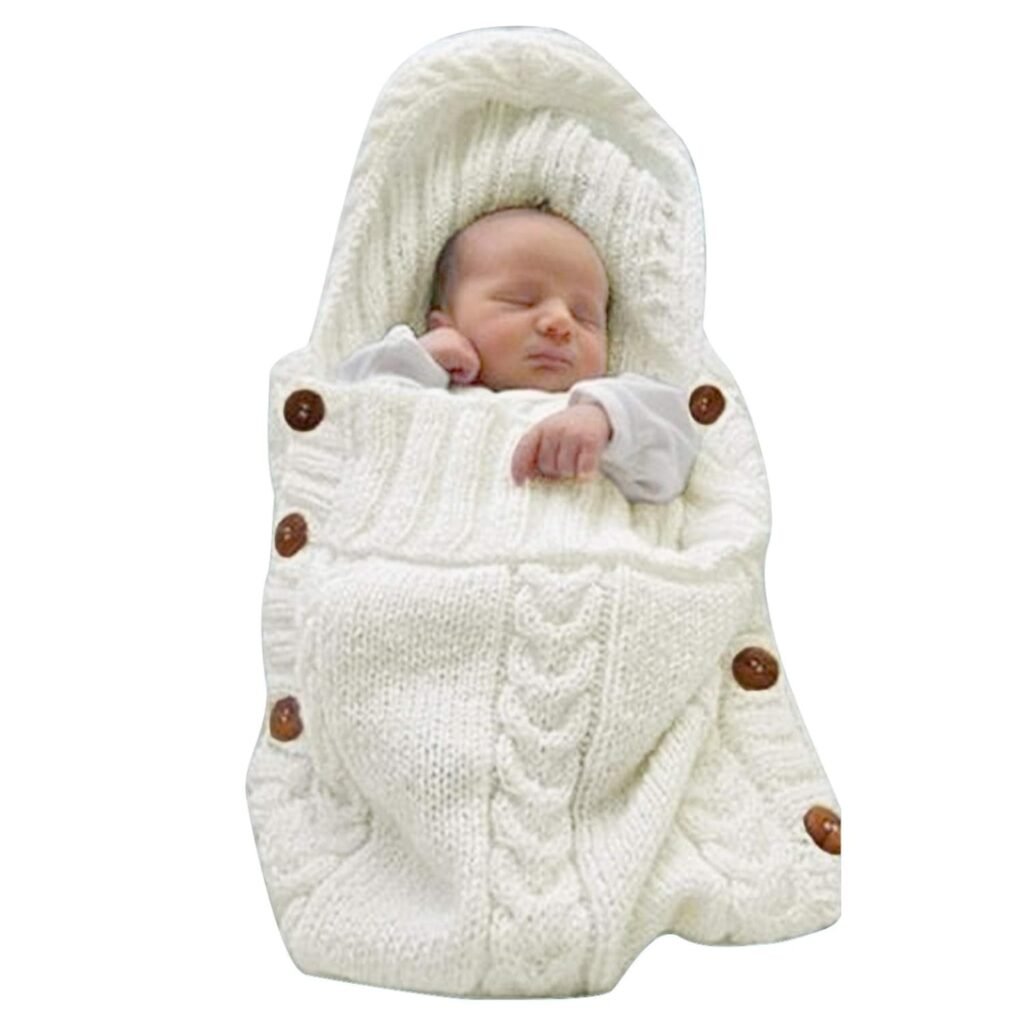
- 100% Acrylic
- 👼Size:Length:45-78cm;Width:35cm(17.5″-30.5″*13.6″)
- 👶Wooden buttons, hooded design
- ✔Knit material is very soft and comfortable to keep your baby warm.
- 👏It is can be used as a blanket, also can be used as Wrap Blanket Bag.
- 🎁Suitable for your baby from 0-6 months. Fast closing/opening by using the buttons and the wrap cloth can be opened comp…
Top 5 Benefits of Baby Clothing Size Guide for Baby & Parents
Developmental & Health Benefits for Baby
Proper Movement Range: Correctly sized clothing allows babies the freedom to kick, reach, roll, and eventually crawl without restriction. This unhindered movement is crucial for muscle development and motor skill acquisition.
Temperature Regulation: A baby clothing size guide helps ensure clothes aren’t too tight (causing overheating) or too loose (allowing too much heat loss). Babies struggle to regulate their body temperature, making properly fitted clothing essential for comfort and health.
Skin Health: Appropriately sized clothing prevents chafing, irritation, and pressure marks that can occur with items that are too small. This is particularly important for babies with sensitive skin or conditions like eczema.
Safe Sleep: Following size recommendations for sleep sacks and wearable blankets reduces hazards associated with loose bedding, supporting safe sleep practices recommended by pediatricians.
Improved Comfort: When clothes fit properly, babies experience fewer distractions from their important work of exploring and learning about their environment. Comfortable babies tend to be more content, potentially supporting better cognitive development.
Advantages for Parents
Using a comprehensive baby clothing size guide offers numerous benefits for parents beyond just having well-dressed babies:
Financial Efficiency: Understanding sizing patterns helps parents make strategic purchasing decisions, buying appropriate quantities in each size and taking advantage of sales for future sizes. This planning can significantly reduce overall clothing expenditure.
Reduced Waste: Accurate sizing knowledge means fewer unworn or barely-worn items that babies quickly outgrow. This is both economically and environmentally beneficial.
Gift Registry Optimization: Parents who understand sizing can create more useful gift registries, specifying varied sizes that will serve their baby through different growth stages.
Simplified Shopping: Once familiar with their baby’s growth pattern and how it correlates with size charts, parents can shop more confidently, even without the baby present. This saves time and reduces shopping stress.
Storage Management: Knowledge of upcoming size needs helps parents organize storage systems for current, upcoming, and outgrown clothing, creating more functional nursery spaces.
Long-Term Impact on Family Wellbeing
The benefits of mastering infant size chart by age interpretation extend beyond immediate practical advantages:
Reduced Parental Stress: Elimination of “nothing fits” emergencies decreases parental anxiety and improves overall family functioning. When parents aren’t scrambling to find clothes that fit, mornings and outings become smoother.
Better Budgeting Habits: The planning skills developed through baby clothing management often transfer to other aspects of family financial planning.
Environmental Consciousness: Parents who become adept at maximizing clothing use often become more sustainability-minded in other consumer choices.
Community Building: Many parents who master sizing systems become resources for their communities, participating in clothing swaps or advising new parents, strengthening social connections.
Long-term Organization Skills: The systems developed for managing baby clothing often evolve into family-wide organizational approaches that serve households well as children grow.
Expert Tips, Alternative Methods & Age-Specific Advice
Tips for Newborns (0-3 Months)
Newborn sizing presents unique challenges due to the tremendous variation in birth weights and lengths. Consider these expert recommendations:
Avoid overbuying newborn sizes: Most babies outgrow true newborn sizes within 2-4 weeks. Start with 5-7 outfits and supplement if needed.
Focus on ease of dressing: Prioritize front-opening designs or wide-neck options that don’t need to go over the head, making dressing easier during the delicate newborn stage.
Consider umbilical cord care: Look for newborn clothes with umbilical cord cutouts or fold-down waistbands until the cord stump falls off.
Prioritize accessibility for diaper changes: Choose items with bottom snaps or zippers for frequent diaper changes.
Check sleeve length carefully: Newborns often have surprisingly long arms relative to their bodies. Ensure sleeves don’t restrict hand movement or bunch at the wrists.
Use the baby clothing size guide measurement indicators: Weight is often more relevant than age for newborns when determining proper fit.
Adjustments for Older Babies & Toddlers (3+ Months)
As babies grow, their proportion and activity level changes, requiring adjustments to sizing approaches:
Accommodate mobility needs: Once babies begin rolling, crawling, and eventually walking, prioritize clothing that allows freedom of movement, particularly in the leg and hip areas.
Account for diaper bulk: Especially important for bottoms, ensure adequate room for diapers without excessive bagging.
Adjust for body type: Some babies develop long torsos with shorter legs, while others show the opposite pattern. Adapt your sizing choices accordingly, potentially selecting different sizes for tops versus bottoms.
Consider developmental milestones: Around 9-12 months, look for reinforced knees for crawlers and elastic waistbands for babies beginning to stand.
Implement seasonal planning: For babies 6+ months, use the infant size chart by age to project what size your baby might wear during upcoming seasons to purchase appropriate seasonal items.
Evaluate neck opening sizes: As babies become more active and develop stronger opinions, wide or stretchy neck openings become increasingly important for dressing cooperation.
Alternative Methods & Different Parenting Styles
Various parenting philosophies influence clothing choices and sizing approaches:
Minimalist Approach:
- Focus on 7-10 high-quality, versatile items per size
- Choose neutral colors for maximum mix-and-match potential
- Select natural fibers that withstand frequent washing
- Prioritize adaptable designs like adjustable waistbands and cuffs
Montessori-Inspired Dressing:
- Select easier-to-manipulate closures to promote independence
- Choose slightly roomier fits to facilitate self-dressing attempts
- Look for clear front/back indicators to help toddlers learn directionality
- Use the baby clothing size guide to ensure proper fit while accommodating independence
Capsule Wardrobe Approach:
- Create seasonal mini-capsules of 15-20 coordinating pieces
- Focus on layer-friendly items with compatible sizing
- Size up slightly in base layers and size accurately for outer layers
- Use infant size chart by age data to project seasonal size needs
Eco-Conscious Sizing Strategy:
- Select brands using “grow-with-me” designs that span multiple traditional sizes
- Choose organic cotton items that typically experience less shrinkage
- Look for adjustable features that extend wear time
- Focus on quality over quantity to maximize hand-me-down potential
Conclusion
Navigating the complex world of baby clothing sizes doesn’t have to be overwhelming. With a comprehensive baby clothing size guide and the practical strategies we’ve covered, you can make confident choices that keep your little one comfortable while maximizing your clothing budget.
Remember these key takeaways:
Measure your baby regularly and rely on actual measurements over age-based recommendations whenever possible.
Allow for growth by selecting appropriate sizing based on your baby’s individual growth pattern rather than strictly following age guidelines.
Create a simple system for organizing current, upcoming, and outgrown clothing to reduce stress and maximize usage.
Consider both comfort and developmental needs when selecting clothes, ensuring freedom of movement as your baby grows.
Adapt your baby clothing size guide strategy based on your baby’s changing needs, seasonal considerations, and your family’s lifestyle.
By mastering these concepts, you’ll spend less time worrying about whether clothes will fit and more time enjoying your baby’s precious early months. The confidence that comes from understanding sizing empowers you to make smart purchasing decisions and create a functional wardrobe that grows with your child.
Share your experience with baby clothing size guide in the comments below! What sizing challenges have you faced, and what solutions worked best for your family? Your insights might help other parents navigating similar situations.
FAQs
How accurate are age recommendations on baby clothing size guides?
Age recommendations on a baby clothing size guide serve as general starting points rather than precise indicators. They typically represent the average baby in the 50th percentile for growth, but babies develop at vastly different rates. A study by the University of Michigan found that by six months of age, babies of the same age could differ in weight by up to 8 pounds and in length by up to 5 inches—differences significant enough to span two or even three clothing sizes.
For the most accurate fit, always prioritize your baby’s actual measurements over the age listed on the tag. Many parents find their babies consistently wear sizes larger or smaller than their age suggests. If your 3-month-old comfortably wears 6-month clothing, this simply means they’re following their unique growth pattern. Track your baby’s growth percentiles from pediatrician visits, as these can help predict whether you should typically size up or down from age recommendations.
What’s the difference between US and European baby clothing sizes?
US and European sizing systems for baby clothes follow fundamentally different approaches, making direct conversion challenging when using a baby clothing size guide. US sizes are primarily age-based (Newborn, 0-3M, 3-6M, etc.), while European sizes typically reference the baby’s height in centimeters (50, 56, 62, etc.).
Here’s a general conversion guideline:
- US Newborn ≈ EU 50-56 (up to 22 inches/56 cm)
- US 0-3M ≈ EU 56-62 (up to 24 inches/62 cm)
- US 3-6M ≈ EU 62-68 (up to 27 inches/68 cm)
- US 6-9M ≈ EU 68-74 (up to 29 inches/74 cm)
- US 9-12M ≈ EU 74-80 (up to 31 inches/80 cm)
- US 12-18M ≈ EU 80-86 (up to 34 inches/86 cm)
- US 18-24M ≈ EU 86-92 (up to 36 inches/92 cm)
European brands tend to fit slimmer and longer than American brands. When purchasing European clothing, consider sizing up if your baby has a chubbier build, and reference the centimeter measurements rather than attempting to convert by age alone.
How do I handle my baby being different sizes in different brands?
Brand inconsistency is one of the biggest challenges when using any baby clothing size guide. To manage this effectively, create a personalized brand reference chart documenting which size in each brand fits your baby currently. For example, your 9-month-old might wear:
- Carter’s: 12 months
- Gerber: 18 months
- H&M: 9-12 months
- Gap: 6-12 months
When shopping online where you can’t try before buying, search for brand-specific size charts that include actual measurements. Compare these to your baby’s current measurements, not their age. For brands you haven’t purchased before, read customer reviews mentioning whether items run large or small.
Another helpful strategy is to establish a “baseline brand” that consistently fits your baby well, then use that as your reference point when trying new brands. Many parents find that keeping a small measuring tape in their diaper bag allows for quick in-store size checks without having to try everything on a potentially uncooperative baby.
How should I measure my baby for the most accurate clothing size?
For the most precise application of any baby clothing size guide, measure your baby when they’re in a calm, cooperative mood. Use a soft fabric measuring tape and record these key measurements:
Weight: Use a baby scale or weigh yourself holding the baby, then subtract your weight.
Length: Lay your baby flat on a firm surface. Gently extend their legs (which they naturally keep slightly bent) and measure from the top of their head to the bottom of their heel. This is their “crown-to-heel” measurement.
Chest: Wrap the measuring tape around the fullest part of your baby’s chest, just under the armpits, keeping the tape parallel to the floor.
Waist: Position the tape around the natural waistline, typically just above the belly button.
Inseam (for pants): Measure from the crotch to the ankle.
Take measurements monthly during rapid growth phases (0-6 months) and every two months thereafter. Record these with dates to track growth patterns. Remember to measure over just a diaper—no clothing—for accuracy, and take each measurement twice to confirm.
When should I size up in baby clothes, and how much growth room is appropriate?
Knowing when to size up is a critical aspect of using a baby clothing size guide effectively. Size up when:
- Current clothes show obvious signs of tightness (restricted movement, marks on skin, difficulty dressing)
- The onesie snaps are pulling or won’t stay closed
- Pants no longer reach the ankle
- Sleeves end above the wrist
- The neck opening seems tight or challenging to get over the head
- Your baby seems uncomfortable or fussy in previously comfortable clothes
For growth allowance, the “two-finger rule” works well: you should be able to slip two fingers comfortably between the clothing and your baby’s skin at the chest, waist, and leg openings. More room than this could create safety issues, particularly for sleepwear.
Different clothing types warrant different approaches to sizing up:
- For everyday play clothes: A slight roominess is fine
- For sleepwear: More precise fitting is important for safety
- For special occasion wear: Consider current fit, as oversized formal clothes can look sloppy
- For seasonal items: Size up more generously for items you want to last a full season
Remember that babies typically slow their growth rate after six months, so the rapid size changes of early infancy won’t continue at the same pace throughout the first two years.